
 01768 369282
 furniture@oakandpineonline.co.uk
No products in the basket.


Buy Furniture, Mango Furniture
Mango wood vs acacia: key differences you should know before buying
02
Nov
Nov
Mango wood vs acacia: key differences you should know before buying
What this article is about
Mango and acacia can both make attractive furniture, but acacia covers many species with different properties. Some named acacias are harder than mango. Mango has warm, varied grain, and Oak & Pine’s current furniture focus is mango wood.
Mango wood and acacia at a glance
| Feature | Mango wood | Acacia |
| Species behind the name | Mango (Mangifera indica) | A large genus with nearly 1,000 species |
| Janka hardness | About 1,070 lbf | Varies; Acacia mangium is about 1,430 lbf |
| Average dried weight | About 675 kg/m³ | Varies; Acacia mangium is about 585 kg/m³ |
| Appearance | Often golden brown; streaks may occur | Many species are medium to dark brown; grain varies |
| Outdoor use | Check product rating and finish | Check species, construction and product rating |
The table compares mango with Acacia mangium, one named species. The figures come from the Wood Database profile for mango and its profile for mangium; they do not represent every acacia sold as furniture. The acacia genus entry describes wider variation in density and hardness. Check the species used in a product before applying a figure to it.
Why the word acacia can be misleading
Acacia is not one single furniture wood. It is a genus of nearly 1,000 species. Some are relatively light; others are among the heaviest and hardest woods. A product title may say acacia without naming the species, making a precise comparison difficult.
Mango is more specific: the furniture timber discussed here is Mangifera indica. Even then, colour, grain and performance can vary between trees and boards. A fair comparison starts by identifying the species behind both product names, then checking dimensions, construction and finish.
Hardness and everyday durability
The Wood Database lists mango at about 1,070 lbf on the Janka scale. Acacia mangium is listed at about 1,430 lbf, while Australian blackwood (Acacia melanoxylon) is about 1,160 lbf and black wattle (Acacia mearnsii) about 1,710 lbf. Those are examples of named species, not a universal acacia rating.
The Janka test measures the force needed to press a steel ball into a wood sample. It helps compare indentation resistance, but does not rate an entire piece of furniture. The thickness and shape of a top, the joints, the finish and the way a table is used all influence how it performs at home.
For a dining table or coffee table, consider the finish and the level of day-to-day use. A harder species may resist dents better in a particular test, but the product still needs sound construction and suitable care. Ask for the specific species and product instructions instead of relying on the word acacia alone.
Colour and grain
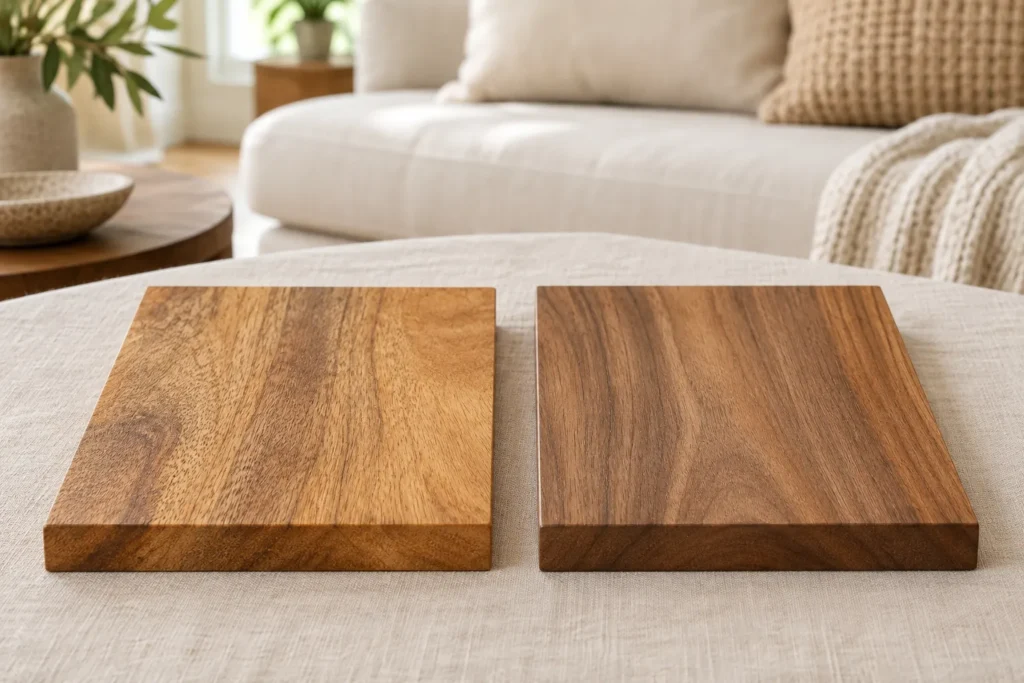
Mango often has a golden-brown base, with natural variation that can include yellow, pink or dark streaks. Straight grain is possible, as are interlocked grain, curl, mottling and spalting. This variation can make the timber a natural focal point, especially in a sideboard, coffee table or other piece where the surface is visible.
Acacia varies because the name covers different species. Many species have medium to dark-brown heartwood, sometimes with a clear contrast between the heartwood and paler sapwood. Grain and figure also differ. A photograph of one acacia table cannot tell you how every acacia item will look.
The finish matters in both cases. It can deepen or even out the colour, and the lighting in a room changes how the surface appears. If you are deciding between two products, compare their actual images and finish descriptions, not just the wood names.
Weight and handling
Reference figures also show why acacia needs a species name. The Wood Database gives mango an average dried weight of about 675 kg/m³ and Acacia mangium about 585 kg/m³. Those values apply to the named woods in the database, not to all mango or all acacia furniture. The finished item’s size, components and hardware affect its actual weight.
For upstairs delivery, check the product’s stated weight and dimensions, and ask how it arrives and whether assembly is required. A general density value is not a substitute for the product specification.
Moisture, finishes and outdoor use
Neither hardwood nor acacia automatically means suitable for outdoor use. Outdoor performance depends on species, construction, joints and the protection applied to the finished piece. Mango’s resistance to decay is described as ranging from moderately durable to perishable in The Wood Database, so it should not be treated as weatherproof timber without a product-specific rating.
Acacia also varies by species. If you are considering garden furniture, ask the seller to identify the species, explain the finish and confirm how the item should be maintained. A wood used outdoors in one design may not be suitable for another product with different joints or coatings.
For indoor furniture, follow the product’s care instructions. Avoid prolonged moisture and strong direct heat, use coasters or mats where appropriate, and clean the surface as recommended. Oak & Pine’s care guide covers mango furniture; the maker’s instructions should guide care for any acacia item.
Price and sustainability
There is no single price or sustainability rating for either wood. Cost depends on size, construction, finish, design and source. Acacia prices also vary with species. Compare similar products and ask the seller what the material description covers.
Mango is grown for fruit, and some timber is used after production declines. That can give the wood a second use, but does not prove an item’s source. The same applies to acacia: the species name alone is not proof of responsible sourcing. See Oak & Pine’s article on mango wood and sustainability, and look for product-specific sourcing details.
Which should you choose?
| If you want… | Mango may suit you when… | Acacia may suit you when… |
| Distinctive grain | You like warm colour variation or patterned designs. | You have seen and like the specific species and finish. |
| Hardness | The product’s construction suits your intended use. | The named species has properties that suit the item’s use. |
| Indoor furniture | You want a piece from Oak & Pine’s mango range. | The seller confirms the species, material and care details. |
| Outdoor furniture | The exact item is rated for outdoor use. | The exact item is rated for outdoor use. |
Oak & Pine now focuses its furniture collection on mango wood. That gives the range a shared material character while allowing different designs to take it in several directions: Agra uses a herringbone parquet pattern, Kodi has a sunburst design, Raipur has a distressed look, and Amereli combines mango with metal. Browse the mango wood collection to see which style works for your room.
Frequently asked questions
Is acacia harder than mango?
Some acacia species are harder than mango, but there is no single figure for all acacia. The Wood Database lists mango at about 1,070 lbf and Acacia mangium at about 1,430 lbf on the Janka scale. Ask the retailer for the exact species before using a number to compare products.
Which is cheaper, mango or acacia?
Neither material is always cheaper. A finished item’s price depends on size, construction, finish, design and source. With acacia, the species may also affect availability and cost. Compare products with similar dimensions and features, and ask the seller to clarify the material description.
Can mango or acacia furniture be used outdoors?
Do not assume that a furniture item is suitable for outdoor use because of its wood name. Outdoor performance depends on the species, construction, joints and protective finish. Check that the exact product is rated for outdoor use and follow its maintenance instructions.
What is the downside of acacia wood?
The main difficulty for a buyer is that acacia can refer to many species with different properties. Without a scientific name, it is hard to compare hardness, weight, colour or durability accurately. Ask the retailer which species is used and what care the finished item needs.
Why you can trust us
Oak & Pine focuses its current furniture collection on mango wood and has a showroom in Kirkby Stephen where visitors can look closely at selected pieces. The team can help with product-specific questions about dimensions, materials, finishes and delivery.
Explore mango wood furniture
If mango’s varied grain and warm tones suit your home, browse Oak & Pine’s mango wood furniture collection. Check the product details and care instructions, or contact the team if you need help choosing.
